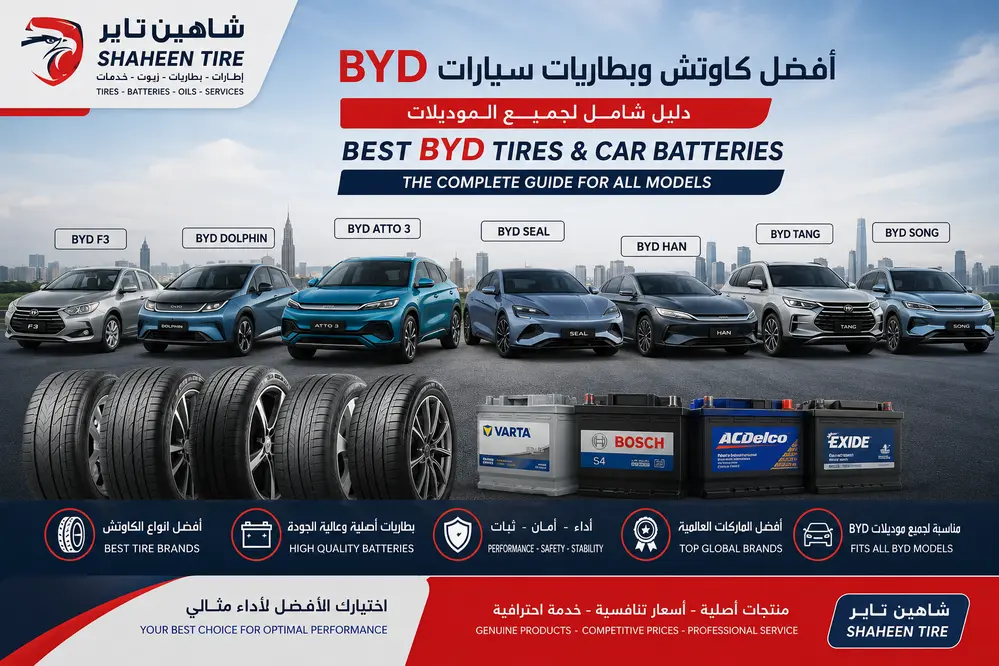
Tyres and batteries for BYD cars
BYD is not a normal car brand asking a normal tyre question. It started as a battery manufacturer and moved into cars, and most of what it sells now is electric. That changes both halves of this article — an electric car is harder on tyres than a petrol car of the same size, and the word "battery" means two completely different things depending on which one you are asking about.
This guide is about what an owner in Egypt actually needs to decide, and it is deliberate about the difference between the two batteries.
First: which battery are you asking about?
This is where most advice about electric cars goes wrong, so it is worth being exact.
| Traction battery | 12V auxiliary battery | |
|---|---|---|
| What it does | Drives the car. This is the car's range. | Runs the locks, lights, screens and computers, and wakes the car up. |
| On a BYD EV | A BYD Blade LFP pack, built into the floor of the car. | A small separate battery, in some models also lithium. |
| Can a tyre and battery shop replace it? | No. It is a high-voltage structural component and dealer-only work. | Sometimes — but only against the exact specification. |
| Is a Varta, Bosch, Exide or ACDelco a substitute? | No. Those are 12V lead-acid starter batteries and have nothing to do with a traction pack. | Only if the car actually uses a lead-acid auxiliary and the specification matches exactly. |
If someone offers to sell you a "replacement battery for your electric BYD" over the counter, ask which of the two they mean. Nobody sells a Blade pack off a shelf.
The BYD F3 is the exception
The F3 is a petrol car. It has a conventional 12V lead-acid starter battery, and everything you would normally do for a petrol saloon applies to it — match the Ah, match the , match the terminal side and the case size against what is fitted. Varta, Bosch and the rest are all valid for it.
The Dolphin, Atto 3, Seal, Han and Tang are not in that category. Do not carry F3 battery advice across to them.
Tyre sizes
BYD fitments vary by market and by trim more than most brands do, and the same model name can carry a different wheel in Egypt than it does in Europe or China. We would rather give you two sizes we can stand behind than seven we cannot.
| Model | Commonly recorded size | Confidence |
|---|---|---|
| Dolphin | 195/60 R16 on the standard car · 205/50 R17 on the extended-range car | Recorded for the 2023 model. Confirm against your own placard. |
| Atto 3 | 215/60 R17 or 235/50 R18 depending on market and trim | Sources disagree by market. Confirm against your own placard. |
| Seal | Check your door placard | Not confirmed for the Egyptian-market car. |
| Han | Check your door placard | Not confirmed for the Egyptian-market car. |
| Tang | Check your door placard | Not confirmed for the Egyptian-market car. |
| F3 | Check your door placard | Varies by year across a long production run. |
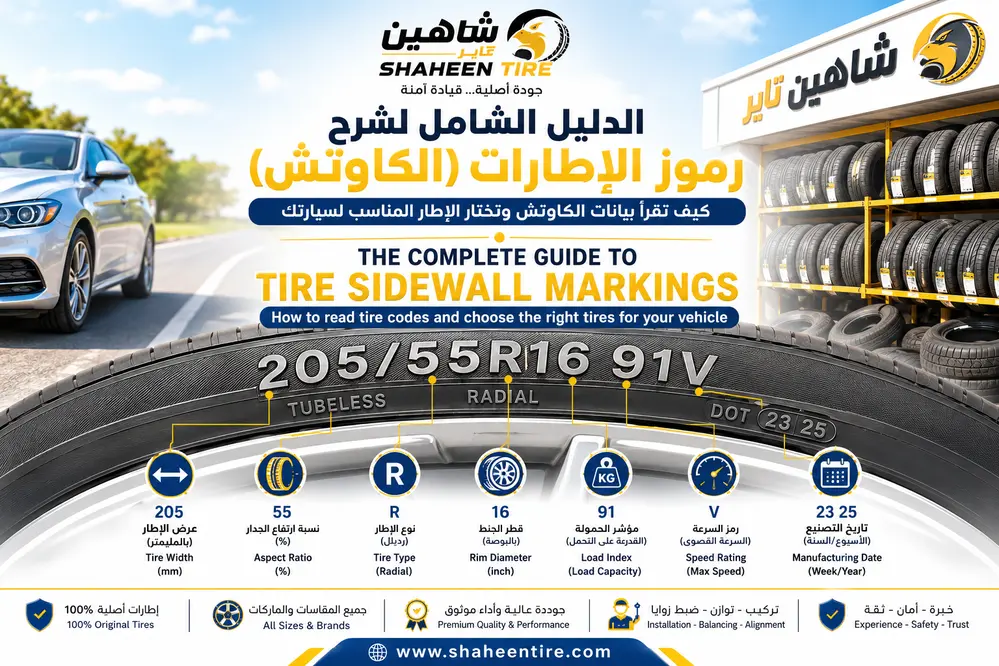
The placard is the sticker inside the driver's door frame. It carries the size, the load index and the correct cold pressures — all three of which matter more on an electric car than they do on a petrol one.
Why an electric car is harder on tyres
This is the part missing from most guides, and it is the reason you should not simply buy the cheapest thing in the right size.
Weight
The battery pack makes an EV several hundred kilograms heavier than a petrol car of the same footprint. That weight has to be carried by the tyre's casing, which is why the load index on the placard is not a suggestion. A tyre with a lower load index than specified is the wrong tyre even if the size reads identically.
Instant torque
An electric motor delivers full torque from a standstill. Rear tyres on a Seal or an Atto 3 wear faster than an owner used to a petrol car expects — often noticeably faster on the driven axle. Rotate on schedule rather than waiting for a visible difference.
Rolling resistance is range
On a petrol car a high-rolling-resistance tyre costs you fuel. On an EV it costs you kilometres of range directly, and you feel it every day. A tyre marketed for low rolling resistance is worth more on an EV than on anything else.
Noise
There is no engine to mask road noise, so tyre roar that would be inaudible in a petrol car is the loudest thing in the cabin. Many EV-specific tyres carry a foam layer bonded inside the casing for exactly this reason.
If you can find a tyre carrying an EV marking from its manufacturer in your size, it is generally worth the difference. If you cannot, prioritise load index first, then rolling resistance, then noise.
Choosing a brand
Michelin, Bridgestone, Continental and Goodyear all produce EV-specific lines and are the safest choice if the budget allows. Hankook and Kumho are competent value options and are widely available in the sizes BYD models use. Pirelli is the sportier choice and suits a Seal driven hard more than a Dolphin used for commuting.
None of that overrides the placard. A premium tyre in the wrong load index is worse than a value tyre in the right one.
Pressure, and why it matters more here
Check pressures cold — before driving, not after — at least once a month, against the placard figure. On an EV, running soft costs range immediately and wears the shoulders of an already heavily loaded tyre. Running hard rides badly and wears the centre.
The number moulded into the tyre sidewall is a maximum the casing can take, not a recommendation for your car. Use the door placard.
When to replace a tyre
- Tread down to the wear bars in the grooves.
- Cracking in the sidewall — heat and sunlight age tyres in Egypt faster than tread wear does.
- Any bulge. That is a broken cord and it will not get better.
- Vibration at a particular speed that survives balancing.
- More than five or six years from the date, whatever the tread looks like.
Signs the 12V battery is failing
On an electric car a failing 12V battery does not sound like a slow crank — there is no starter motor. It looks like electrical strangeness instead:
- The car will not wake up or unlock, even though the traction battery shows plenty of charge.
- Screens reboot, or warning lights appear that make no sense together.
- The car reports a 12V system fault directly.
A car that shows 70% on the dashboard and still refuses to start is almost always a 12V problem, not a range problem. It is also the single most common EV breakdown call there is.
Getting it right in Tanta
Bring the car to Shaheen Tire and we will read the placard with you, confirm the size and the load index, and tell you honestly whether what you need is something we stock or something that has to go to a BYD dealer. On an electric car, knowing which of those two it is saves you the most money.