Every tyre carries its own spec sheet, moulded into the rubber on its side. Once you know how to read it, you can tell in a few seconds whether a tyre fits your car, how much weight it can carry, how fast it is rated for, and how old it is. That last one matters more than most buyers realise.
This guide walks through each marking in the order you will find it on the sidewall, and explains what to do with the information.
Start with the size code
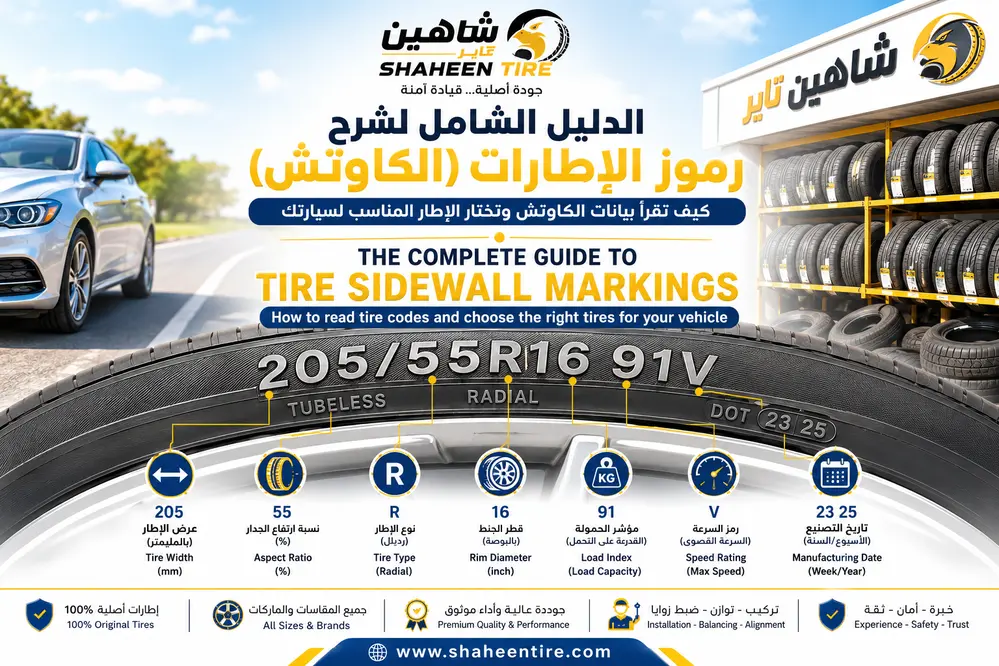
The biggest, clearest marking on the sidewall is the size. It looks like this:
205/55 R16 91 V
Five pieces of information, one after the other:
| Part | Means | In this example |
|---|---|---|
| 205 | Section width in millimetres | The tyre is 205 mm wide |
| 55 | Aspect ratio: sidewall height as a percentage of the width | Sidewall height is 55% of 205 mm, about 113 mm |
| R | Radial construction | A radial tyre, which is what virtually every modern car uses |
| 16 | Rim diameter in inches | Fits a 16-inch wheel |
| 91 V | Service description: load index, then speed rating | 615 kg per tyre, rated to 240 km/h |
Write your current size down before you shop. The same car can be sold with two or three approved sizes, and a tyre that is one number off in width or profile will change how your speedometer reads and how the car sits.
Width, profile and rim diameter
Width (the first number)
Section width is measured in millimetres from sidewall to sidewall when the tyre is mounted and inflated. A wider tyre puts more rubber on the road, which generally helps grip, but it also costs a little fuel economy and can rub against the bodywork if you go too far.
Aspect ratio (the second number)
This is a percentage, not a measurement. A 55 means the sidewall is 55% as tall as the tyre is wide. A lower number means a shorter, stiffer sidewall: sharper steering response, but a harder ride and less protection from potholes. A higher number gives a taller, softer sidewall that absorbs road shocks better.
R (construction)
R stands for radial, the construction where the internal cords run across the tyre at 90 degrees to the direction of travel. You may occasionally see a D (diagonal, also called bias-ply) on older or specialised tyres. Do not mix construction types on the same car.
Rim diameter (the third number)
This one is not flexible. A 16-inch tyre fits a 16-inch wheel and nothing else. Note that this number is in inches while the width is in millimetres, which is a quirk of how the standard evolved.
Load index: the number that carries your car
The load index is a code, not a weight. The number 91 does not mean 91 of anything. It points to a row in a standard table, and that row gives the maximum weight one tyre can carry at its rated pressure. Load index 91 means 615 kg per tyre.
Multiply by four and you get the load the full set can support. Your car's required minimum load index is printed on the placard inside the driver's door or in the owner's manual. Fitting a lower index than the car calls for is dangerous, especially on a loaded car in summer heat.
| Load index | Maximum load per tyre (kg) |
|---|---|
| 75 | 387 |
| 76 | 400 |
| 77 | 412 |
| 78 | 425 |
| 79 | 437 |
| 80 | 450 |
| 81 | 462 |
| 82 | 475 |
| 83 | 487 |
| 84 | 500 |
| 85 | 515 |
| 86 | 530 |
| 87 | 545 |
| 88 | 560 |
| 89 | 580 |
| 90 | 600 |
| 91 | 615 |
| 92 | 630 |
| 93 | 650 |
| 94 | 670 |
| 95 | 690 |
| 96 | 710 |
| 97 | 730 |
| 98 | 750 |
| 99 | 775 |
| 100 | 800 |
| 101 | 825 |
| 102 | 850 |
| 103 | 875 |
| 104 | 900 |
| 105 | 925 |
Indices below 75 and above 105 exist and are common on very small cars, pickups and vans. If your tyre falls outside this range, ask us and we will confirm the exact figure from the standard table.
Going up in load index is generally safe. Going down is not. If your car specifies 91 and the shop offers you 88, that is 55 kg less capacity per corner, or 220 kg across the car.
Speed rating: the letter after the load index
The speed rating is the maximum speed the tyre is certified to sustain under test conditions at its rated load. It is not a recommendation and it is not a licence, but it does describe how the tyre is built. A higher-rated tyre generally uses stiffer construction and a harder compound.
| Symbol | Maximum rated speed |
|---|---|
| L | 120 km/h |
| M | 130 km/h |
| N | 140 km/h |
| P | 150 km/h |
| Q | 160 km/h |
| R | 170 km/h |
| S | 180 km/h |
| T | 190 km/h |
| U | 200 km/h |
| H | 210 km/h |
| V | 240 km/h |
| W | 270 km/h |
| Y | 300 km/h |
| (Y) | Above 300 km/h |
Two things trip people up here. First, the letters are not alphabetical: H sits between U and V, a leftover from how the standard was extended over the years. Second, ZR is not a row in this table. ZR in a size code marks a tyre built for speeds above 240 km/h, and the actual limit is given by the W or Y in the service description that follows it.
Most cars on Egyptian roads are fitted from the factory with T, H or V rated tyres. Matching or exceeding what the manufacturer specified is the safe choice.
XL, Reinforced and other load markings
Some sidewalls carry XL (Extra Load) or Reinforced next to the size. These are the same thing: a tyre built with a stronger casing that carries more weight than the standard version of that size, at a higher inflation pressure. An XL tyre will show a higher load index than its standard-load equivalent.
Other load-related markings you may see:
- SL (Standard Load) — the normal version, often not printed at all.
- C or LT — Commercial or Light Truck, built for vans and pickups. These usually carry two load indices, one for single fitment and one for dual rear wheels.
- MAX LOAD — the same capacity written out in kilograms and pounds, alongside the pressure it applies at.
If your car came with XL tyres, replace them with XL tyres. Standard-load versions of the same size will not carry the same weight.
The DOT code: how old is this tyre?
stands for Department of Transportation. The code that follows it is the Tire Identification Number, and it records the manufacturer, the plant, and, crucially, the date of manufacture.
The last four digits are the date: the first two are the week of the year, the last two are the year.
- 2521 — week 25 of 2021
- 0824 — week 8 of 2024
- 4919 — week 49 of 2019
This is the single most useful marking on the tyre and the one people most often skip. Rubber ages whether it is driven on or not. A tyre that sat in a warehouse for four years is a four-year-old tyre, even with full tread and no mileage on it. Heat accelerates this, and Egyptian summers are not gentle.
Check the date code before you pay, not after fitting. Ask to see it on all four tyres. At Shaheen Tire we will show you the code on any tyre in the shop.
One detail worth knowing: the full DOT code is only required in full on one side of the tyre. If you cannot find the date, look at the other sidewall.
Treadwear, Traction and Temperature
These three grades are the Uniform Tire Quality Grading system, created by the American highway safety regulator. They appear as a number and two letters, for example TREADWEAR 400 TRACTION A TEMPERATURE A.
| Grade | Scale | What it measures |
|---|---|---|
| A number, typically 100 to 800 | Expected wear life relative to a reference tyre graded 100. A 400 tyre is expected to last four times as long as the reference under the same test. | |
| Traction | AA, A, B, C (AA is best) | Straight-line braking grip on wet asphalt and concrete. It does not measure cornering, dry braking or snow. |
| Temperature | A, B, C (A is best) | Resistance to heat build-up at speed. In a hot climate this grade is worth paying attention to. |
One caution: treadwear numbers are assigned by each manufacturer from their own testing, so they compare well within a brand and less reliably across brands. Traction and Temperature are graded against fixed thresholds and are more directly comparable.
Tubeless, and what goes inside
TUBELESS or TL means the tyre seals against the rim itself and needs no inner tube. Almost every modern passenger car tyre is tubeless. TUBE TYPE or TT means the tyre requires an inner tube to hold air.
Never fit a tube inside a tubeless tyre as a shortcut around a leak, and never run a tube-type tyre without its tube. The two are built differently on the inside and mixing them causes heat build-up and sudden failure.
The pressure on the sidewall is not your pressure
Sidewalls carry a marking like MAX. PRESS. 350 kPa (51 PSI). This is the maximum pressure the tyre structure is designed to hold. It is not the pressure you should inflate to.
Your correct pressure comes from the car, not the tyre. Look for the placard on the driver's door frame, inside the fuel filler flap, or in the owner's manual. It will usually list a normal figure and a higher figure for a fully loaded car.
Check pressures cold, before driving, at least once a month. Under-inflation is the most common cause of tyre failure, and it is invisible on a modern low-profile tyre until it is far too low.
Direction, inside and outside
Some tyres can only be fitted one way round, and the sidewall says so:
- ROTATION with an arrow — a directional tread. The arrow must point in the direction the wheel turns when the car is moving forward. Fitted backwards, the tread pattern stops clearing water and wet grip drops sharply.
- OUTSIDE and INSIDE — an asymmetric tread. The side marked OUTSIDE must face away from the car.
Both markings exist because the tread pattern is not symmetrical, and a fitter working quickly can get them wrong. It costs nothing to walk around the car and check before you drive away.
TWI: the wear bars that tell you when to stop
TWI stands for Tread Wear Indicator. Look for small triangles, the letters TWI, or a brand logo arranged around the shoulder of the tyre. Follow each mark inwards and you will find a raised bar sitting in the bottom of the main groove.
Those bars sit at 1.6 mm of remaining tread depth, the internationally recognised minimum. When the surface of the tread wears down level with the bars, the tyre is finished. Wet braking distance rises steeply in the last couple of millimetres, long before the tyre looks bald.
Do not wait for the bars if you drive in rain. Many manufacturers recommend replacing well before 1.6 mm for wet-weather safety.
Other markings you will see
Weather and surface designations
- M+S (Mud and Snow) — a tread-pattern designation. It describes the geometry of the blocks and grooves, and the manufacturer applies it themselves. It is not a tested performance claim.
- 3PMSF, the three-peak mountain with a snowflake — this one is earned. The tyre must pass a standardised snow traction test to carry it. In Egypt it is rarely relevant, but it is worth knowing the difference if you are reading imported stock.
- A/T, M/T, H/T — All Terrain, Mud Terrain, Highway Terrain. Marketing designations for SUV and pickup tyres, describing the balance between off-road bite and on-road quietness.
Codes and abbreviations
- E4, E11 and similar in a circle — European type-approval, the number identifying the country that granted it.
- Made in ... — country of manufacture, which is not always the country of the brand.
- MFS or FR — a moulded rim protector, a raised rib that shields the alloy wheel from kerb damage.
- OE codes such as MO, AO, ★, N0 — the tyre was developed to a specific carmaker's specification. Useful to know, not something you must match.
- RUN FLAT, RFT, ZP, SSR — reinforced sidewalls that let the tyre run a limited distance at low speed after losing pressure. Only fit these if your car came with them.
How to read your own tyre in one minute
- Find the size code. Write down all five parts, including the load index and speed rating.
- Open the driver's door and read the placard. Compare the size and the minimum load index. They should match.
- Find the DOT code and read the last four digits. Now you know the tyre's age.
- Look at the shoulder for TWI marks and check how close the tread is to the bars.
- Check the pressure cold against the placard figure, not the sidewall figure.
Mistakes we see most often
- Buying on price and size alone. Two tyres in 205/55R16 can have different load indices and speed ratings, and different ages.
- Dropping the load index to save money. The one number that must never go down.
- Ignoring the date. A cheap tyre that was made five years ago is not cheap.
- Mixing sizes across an axle. Both tyres on the same axle should be the same size, construction, and ideally the same model.
- Inflating to the sidewall maximum. That number is a ceiling, not a target. Over-inflated tyres wear down the centre and lose grip.
- Fitting a directional tyre backwards. Easy to do, easy to check.
If you have the markings from your current tyres and you are not sure what they mean, bring the numbers to us or send them over. Reading a sidewall correctly takes a minute and saves a great deal more than that.