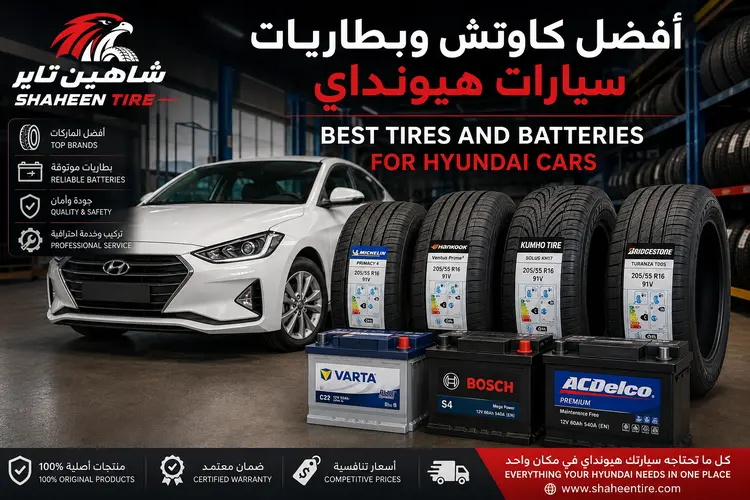
Hyundai is one of the two or three best-selling marques on Egyptian roads, and the question we get across the counter in Tanta every week is the same one: what size does my car take? Most articles about Hyundai tyres answer that with a list of brand names. This one answers it with sizes, generation by generation — and tells you honestly where we could not confirm a number.
First: Accent and Verna are the same car
This confuses more Egyptian buyers than any other Hyundai question, so let us clear it up before the table.
Hyundai sells one small saloon under different names in different markets. It is the Accent in North America, the Gulf and most of the world, and the Verna in India, in China and — importantly for us — in Egypt, where the facelifted fourth-generation car was sold under the Verna name until around 2019.
So if your registration says Verna and the man in the shop says Accent, nobody is wrong. What matters is the generation and the year, not the badge. A 2013 Verna and a 2013 Accent take the same tyre.
Never buy a tyre by model name alone. "Accent" covers three completely different cars built between 2005 and today, on rims from 14 to 17 inches. The year is what decides the size.
Hyundai OE tyre sizes by model and generation
These are original-equipment sizes — what the factory fitted. Where a generation offers several, the smaller size is the base trim and the larger one is the higher trim, so your car has one of them, not all of them. Check which before you buy.
| Model (generation) | Years | OE tyre sizes | Notes |
|---|---|---|---|
| Accent / Verna (RB/RC) | 2010–2023 | 175/70R14 · 185/65R15 · 195/55R16 | Middle East and North Africa spec, confirmed. 185/65R15 is by far the most common on Egyptian cars. |
| Accent (HC/YC) | 2017–2022 | 185/65R15 · 205/45R17 | Middle East spec, confirmed. Note there is no 16-inch factory size in this spec — it jumps 15 to 17. |
| Elantra (MD/UD) | 2011–2015 | 195/65R15 · 205/55R16 · 215/45R17 | Confirmed from general fitment data, not filtered to Middle East spec. Verify against your door sticker. |
| Elantra (AD) | 2016–2020 | 195/65R15 · 205/55R16 · 225/45R17 | Confirmed from general fitment data. The 225/40R18 on Sport/N Line trims is not usually seen here. |
| Elantra (CN7) | 2021–2024 | 195/65R15 · 205/55R16 · 205/50R17 · 225/45R17 | Middle East spec, confirmed, 1.6 MPi. Four factory sizes on one generation — check the sticker. |
| Tucson (TL) | 2016–2020 | 225/60R17 · 225/55R18 · 245/45R19 | Confirmed at generation level, not filtered to Middle East spec. |
| Tucson (NX4) | 2021 onward | 215/65R17 · 235/55R18 · 235/50R19 | Middle East and North Africa spec. Read the warning below — the American car is different. |
| Creta (GS) | 2015–2021 | 205/65R16 · 215/60R17 | 16-inch on base and mid trims, 17-inch on the top trims. |
| Creta (SU2) | 2020 onward | 205/65R16 · 215/60R17 | Middle East and North Africa spec, confirmed. Same two sizes as the previous generation. |
The Tucson trap: our spec is not the American spec
This is the one to be careful with, because the internet will lie to you. The current Tucson NX4 sold in the Middle East and North Africa runs 215/65R17, 235/55R18 and 235/50R19. The same car sold in the United States runs 235/65R17, 235/60R18 and 235/55R19.
Every one of those pairs is a different tyre. If you search "Tucson 2023 tyre size" in English you will land on an American page, order 235/65R17 for a car that came on 215/65R17, and end up with a taller, wider tyre that reads your speedometer wrong and may rub at full lock. Same model, same year, different market — different tyre.
How to be certain, in ten seconds
The table above is a guide. The car itself is the authority, and it tells you three ways:
- Open the driver's door and look at the sticker on the door frame or door pillar. It gives the exact size the factory fitted to your car, plus the recommended pressure front and rear.
- Look at the owner's manual, in the tyres and wheels section.
- Read the sidewall of the tyre currently on the car — but only trust this if you know a previous owner did not change the size.
The sticker is the one that settles arguments. Most Hyundai saloons and the Creta ask for around 2.3 bar (33 psi) cold, but read your own sticker rather than taking that number from an article — pressure changes with trim, load and tyre size.
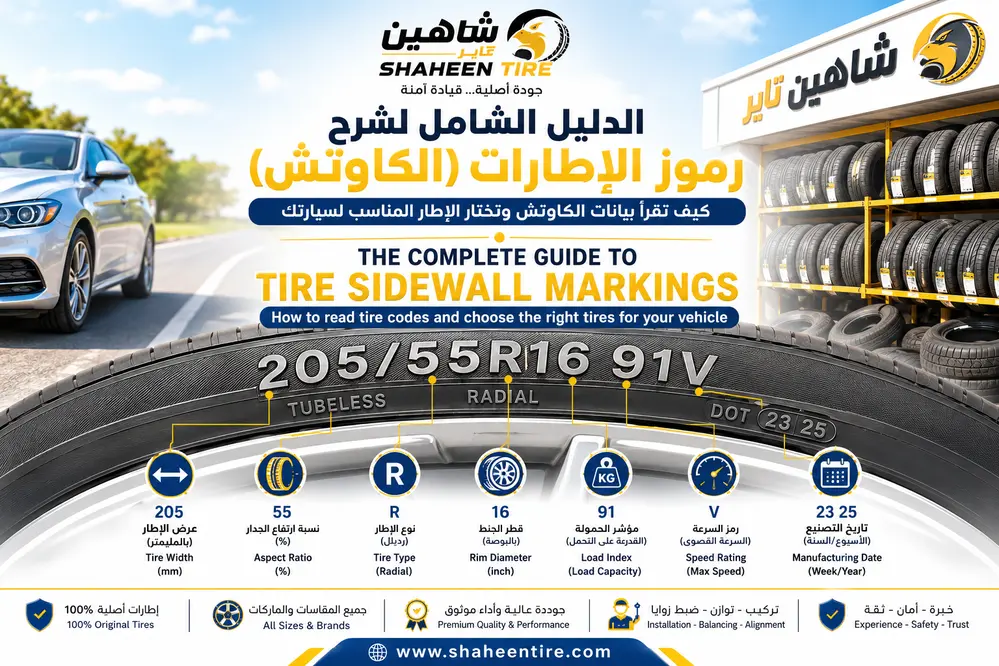
When you read the size, read the two characters after it as well. On 185/65R15 88H, the 88 is the load index and the H is the speed rating. Never fit a tyre with a lower load index than the factory called for — that is the number that carries the car, and dropping it is how sidewalls fail on a hot Delta road in August.
Choosing the tyre once you know the size
Size is not a preference, it is a specification. Everything after the size is where you actually get to choose:
- Match or exceed the factory load index and speed rating. Going up a speed rating is fine; going down is not.
- Check the code on the sidewall before you pay. The last four digits are the week and year the tyre was built — 3225 means week 32 of 2025. A tyre that has been sitting in a warehouse for four years is not new, whatever the tread looks like.
- Buy all four the same, or at minimum the same pair on the same axle — same brand, same pattern, same size. Mixed patterns front to back change how the car behaves when you brake hard.
- For a Tucson or a Creta, remember it is a heavier car with a higher centre of gravity. Sidewall strength matters more than it does on an Accent.
Batteries for Hyundai: match, do not guess
Battery specs vary by engine, by trim and by whether the car has stop-start — so much so that publishing a single figure for "the Elantra" would be a guess dressed up as advice. We are not going to do that. Here is what actually decides it.
The four things that must match
- Capacity in Ah. Read it off the label of the battery currently in the car. Match it, or go slightly above it — never below, and never far above, because a much larger battery may not charge fully on the car's alternator profile.
- Cold cranking amps (). This is the punch it delivers to turn the engine over. Match or exceed the fitted figure. In Egypt heat is the killer rather than cold, but CCA is still the standard measure of starting power and a battery that is short on it will struggle as it ages.
- Terminal side and polarity. Stand at the front of the car and note which side the positive terminal is on. Get this wrong and the cables will not reach — this is the single most common reason a battery goes back to the shop.
- Case size and the hold-down. The battery has to physically sit in the tray and be clamped down. A battery that moves is a battery that vibrates itself to death.
The quickest reliable method: photograph the label on your current battery before you come in. Everything we need is on it.
About the Hankook battery question
People often ask whether Hankook makes batteries, or assume the claim is a mix-up with the tyre company. Both halves are half right. Hankook Tire does not make batteries — but ATLASBX, the automotive battery brand of Hankook & Company, does. It is a genuine lead-acid battery manufacturer with two plants in Korea and one in Tennessee, exporting to over 120 countries, and the units are commonly sold badged Hankook.
So a Hankook-badged battery is a real product from a real manufacturer. That still does not tell you it is right for your car — the Ah, CCA, terminal side and case size decide that, not the name on the top.
When to replace
Tyres
- Tread down to 1.6 mm — the legal and practical minimum. The wear bars moulded into the grooves are level with the tread when you reach it.
- Cracking in the sidewall or between the tread blocks. Egyptian sun ages rubber faster than Egyptian kilometres wear it, and a cracked five-year-old tyre with deep tread is still finished.
- Any bulge in the sidewall. That is structural, it is not repairable, and it does not wait politely — replace it the same day.
- As a rule of thumb, plan on replacement around five years from the DOT date regardless of mileage, and inspect annually after that.
Batteries
- The engine turns over slowly, especially the first start in the morning.
- Headlights dim noticeably at idle and brighten when you rev.
- The battery warning light comes on — although this often points at the alternator rather than the battery, so have both tested.
- The case is swollen, or there is white or green crust on the terminals.
A battery rarely dies without warning; it dies without anyone listening. The slow crank in the morning is the notice period. Get it tested then, not on the morning it refuses.
What we can do for you
Bring the car to Shaheen Tire in Tanta, or send us a photo of the door sticker and the label on your battery. We will confirm the exact size and spec for your car before anything is ordered — because the cheapest tyre is still the wrong one if it is the wrong size.