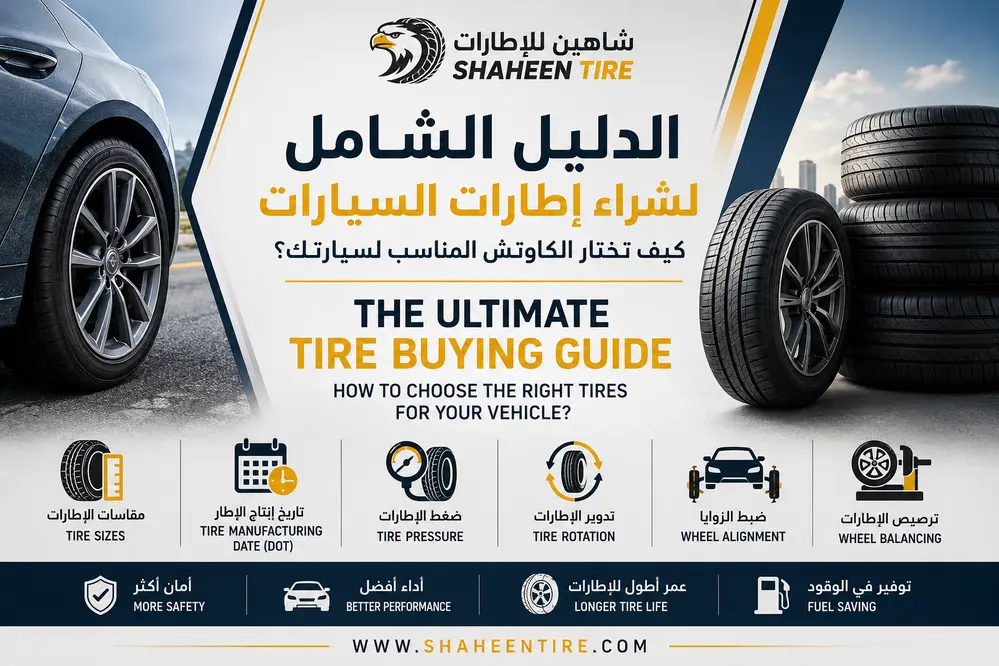
Your tyres are the only part of your car that ever touches the road. Four contact patches, each about the size of a hand, carry everything the car does — accelerating, braking, steering, and staying put in a corner. Every other safety system on the car works through them.
Most people still buy on price alone. This guide covers what to look at instead: how to read the size, when a tyre is finished, what pressure to run, what the maintenance jobs actually do, and the mistakes we see most often across the counter in Tanta.
Why the right tyre matters
Fitting the tyre the car was designed for gives you shorter braking distances, more predictable steering, better grip in rain, less noise in the cabin, and less strain on the suspension. Fuel consumption improves too, because a correctly specified and correctly inflated tyre rolls with less resistance.
Fitting the wrong one costs you in the same places. Uneven and premature wear, longer stopping distances, a car that feels vague at speed, higher fuel use, and repair bills further down the line for parts that were never meant to absorb the difference.
The cheapest tyre is rarely the cheapest tyre. A set that wears out in 20,000 km costs more per kilometre than a better set that runs 45,000 km, before you count the fuel.
Reading the size on the sidewall
The size is the biggest marking on the side of the tyre. It looks like this: 205/55 R16 91V. Six pieces of information in one string.
| Element | Name | What it means |
|---|---|---|
| 205 | Section width | The tyre is 205 mm wide from sidewall to sidewall, mounted and inflated. |
| 55 | Aspect ratio | A percentage, not a measurement. The sidewall is 55% as tall as the tyre is wide — about 113 mm here. Lower means a stiffer, sportier sidewall; higher means more comfort and more protection from potholes. |
| R | Construction | Radial, the construction virtually every modern car uses. |
| 16 | Rim diameter | Fits a 16-inch wheel, and nothing else. This one is in inches while the width is in millimetres. |
| 91 | Load index | A code pointing to a maximum weight per tyre in a standard table. 91 means 615 kg. Never fit a lower index than your car calls for. |
| V | Speed rating | The maximum speed the tyre is certified for at its rated load. V is 240 km/h. |
That is enough to shop with. If you want the full picture — the complete load index and speed rating tables, the date code, XL and Reinforced, the UTQG grades, directional and asymmetric markings — we cover every marking on the sidewall in a separate guide: The complete guide to tyre sidewall markings.
Can you fit a different size?
Sometimes, within the range the car maker approves. But the size affects more than looks. Change the overall rolling diameter and you change what your speedometer reads, and you feed wrong wheel-speed data to the ABS and the stability control. Width that is too great can rub on the bodywork at full lock or over bumps.
The safe rule: stay with a size listed on the placard inside the driver's door or in the owner's manual. If you want to change, have it calculated properly first — bring us the current size and the wheel you intend to use.
When to replace a tyre
Age alone is not the test, and neither is mileage. There are five things to look for.
1. The tread has worn down to the wear bars
Every tyre is moulded with tread wear indicators — small raised bars sitting in the bottom of the main grooves. Find them by looking for the letters TWI, a small triangle, or a brand logo around the shoulder of the tyre, then following that mark inwards to the nearest groove.
Those bars sit at 1.6 mm of remaining tread depth. That figure is the minimum recognised across Europe and the UK and is what the bars are moulded to internationally, which is why every tyre sold anywhere carries them at that height. When the tread surface is level with the bars, the tyre is finished — replace it.
Two things worth knowing. First, wet braking distance rises sharply over the last two or three millimetres, long before a tyre looks bald, so many manufacturers advise replacing earlier than 1.6 mm if you drive in rain. Second, check the depth in several places around the tyre and across its width — a tyre worn on one edge only is telling you something about alignment or pressure, and that problem will eat the new tyre too.
We are not aware of a published Egyptian legal minimum tread depth, so we do not quote one. 1.6 mm is the internationally recognised replacement point marked on your tyre, and it is the number to work to.
2. Cracks in the rubber
Fine cracks in the sidewall or between the tread blocks mean the rubber has hardened and lost its flexibility. Sun, heat, long periods parked without moving, and simple age all cause it. In Egyptian summers it happens faster than the mileage suggests.
3. A bulge in the sidewall
A bulge or blister means the internal cords have broken, usually from a hard pothole or kerb strike. There is no repair for this. Replace the tyre immediately — a bulged sidewall can let go without warning at speed.
4. Repeated punctures and repairs
One properly plugged puncture in the tread area is fine. A tyre that keeps coming back, or that has been repaired several times, or that has damage in the shoulder or sidewall, is not worth keeping. Sidewall damage is never repairable.
5. Age, even with tread left
Rubber ages whether you drive on it or not. A tyre that sat in a warehouse for four years is a four-year-old tyre with zero kilometres on it. Read the DOT date code before you pay — the last four digits are the week and the year of manufacture, so 2525 is week 25 of 2025. Ask to see it on all four.
Tyre pressure: the number comes from your car, not your tyre
Pressure is the single cheapest thing you can get right, and the one most often wrong.
There is no universal correct PSI. The right pressure is set by the vehicle manufacturer for your specific car — its weight, its suspension, its load rating — and it is printed on the vehicle itself. Look for the placard on the driver's door frame or door edge; if it is not there, check inside the fuel filler flap, inside the glovebox lid, or in the owner's manual. It will normally give an everyday figure and a higher figure for a fully loaded car, and often a separate figure for the spare.
The big number moulded on the sidewall — something like MAX. PRESS. 350 kPa (51 PSI) — is not your pressure. That is the maximum the tyre casing is built to hold. Inflating to it will wear the centre of the tread and reduce grip.
Check the pressure cold. Cold means the car has not been driven for at least three hours, or has covered less than about 1.5 km at low speed. Driving heats the air inside the tyre and raises the reading, so a warm check will make an under-inflated tyre look correct.
| Condition | What you get |
|---|---|
| Under-inflated | Higher fuel consumption, the tyre runs hot, both shoulders wear away while the centre stays good, vague steering, and a real risk of sudden failure at speed. |
| Over-inflated | Harsh ride, a smaller contact patch, the centre of the tread wears out first, and less grip — especially in the wet. |
| At the placard figure | Even wear across the tread, the braking distance the car was designed for, and the fuel economy it was tested at. |
Check all four cold, once a month, and before any long drive. Do the spare at the same time — it is the one nobody checks until the day it is needed.
Choosing the right tyre for how you actually drive
Your roads
City-only driving, motorway commuting, and rough or unpaved surfaces put completely different demands on a tyre. Short city trips are hard on the shoulders from constant steering; motorway kilometres are hard on heat resistance; broken surfaces need a tougher casing and a taller sidewall.
Your climate
In Egypt, heat is the dominant factor. Sustained high ambient temperature plus hot asphalt means heat resistance matters more than snow performance ever will. The UTQG Temperature grade on the sidewall — A, B or C, with A best — is directly relevant here in a way it is not in northern Europe.
Your driving style
Relaxed driving is best served by a comfort-oriented tyre: softer sidewall, quieter tread pattern. Harder driving wants a stiffer casing and a higher speed rating for steering response and stability. Both are valid; buying the wrong one for your temperament just means you dislike the car for the next four years.
Your budget
Budget is real and there is no point pretending otherwise. Work out the cost per kilometre rather than the cost per tyre, and never economise by dropping the load index or the speed rating below what the car specifies. Those two are safety specifications, not features.
Economy, mid-range and premium: what actually differs
| Tier | Suits | Trade-off |
|---|---|---|
| Economy | Low annual mileage, city driving, older cars, second cars. | Lowest purchase price. Typically shorter tread life and longer wet braking distances than the tiers above. Fine when it is a genuine, certified tyre in the correct size and rating — the risk is unbranded stock of unknown age. |
| Mid-range | Most drivers, most cars, mixed city and highway use. | The best cost-per-kilometre for the majority of buyers. Usually built by, or to the specification of, a major manufacturer. |
| Premium | Newer cars, higher-powered cars, long highway distances, anyone who wants the shortest braking distances. | Highest price, best wet and dry braking, lowest noise, longest tread life, most consistent behaviour as the tyre wears. The gap shows up most in emergency braking and in rain. |
The important point: the tier is not the only thing that decides quality. A premium tyre in the wrong size, or three years old on the shelf, is worse than a mid-range tyre in the right size made last month.
Rotation, alignment and balancing are three different jobs
These get used interchangeably in conversation and they are not the same thing at all.
| Job | What it does | Do it when |
|---|---|---|
| Tyre rotation | Moves the tyres between positions on the car so they wear evenly. Front and rear positions wear at different rates and in different places. | At the interval in your owner's manual, or whenever you notice the fronts wearing faster than the rears. |
| Wheel alignment | Resets the angles at which the wheels sit relative to the road and to each other, back to the car maker's specification. It is a suspension adjustment, not a tyre job. | The car pulls to one side, the steering wheel sits off-centre when driving straight, or one edge of a tyre is wearing faster than the rest. Also after hitting something hard. |
| Wheel balancing | Adds small counterweights to the rim so the wheel and tyre assembly spins without a heavy spot. | Every time a tyre is fitted to a rim, and any time you feel a vibration through the steering wheel or the seat at speed. |
Skipping alignment is the expensive one. A car that is out of alignment will destroy a brand-new set of tyres on one edge in a few thousand kilometres, and the tyres get blamed for it.
Making a set last longer
- Check pressures cold, once a month, all five tyres including the spare.
- Rotate at the interval your manual specifies.
- Get the alignment checked when you fit a new set, and any time the car starts pulling.
- Have the wheels balanced whenever you feel a vibration.
- Avoid hard acceleration and heavy braking — both scrub rubber off for nothing.
- Slow down for potholes and do not kerb the wheels when parking. Impact damage is the main cause of sidewall bulges.
- Do not load the car beyond its rated weight.
- Deal with small punctures straight away rather than topping the tyre up every week. Running a slowly deflating tyre destroys it from the inside.
- Park in shade where you can. Sustained direct sun ages the rubber.
Mistakes we see most often
- Buying on price alone. Two tyres in the same size can have different load indices, different speed ratings and different ages.
- Not checking the DOT date. A discounted tyre that was made four years ago is not a discount.
- Dropping the load index or speed rating. The two numbers that must never go below what the car specifies.
- Changing size by eye. Wider tyres on the same rim, or a different profile, without checking the rolling diameter against the original.
- Replacing one tyre and ignoring the other on the same axle. Both tyres on an axle should match in size, construction and, ideally, model. On a four-wheel-drive car, mismatched rolling diameters can damage the drivetrain — check the manual.
- Inflating to the sidewall maximum. That is a ceiling, not a target.
- Skipping the checks after fitting. Balancing, pressures, alignment if needed, and wheel nuts torqued to spec — then re-checked after the first hundred kilometres or so.
Frequently asked questions
When is the right time to change tyres?
When the tread reaches the wear bars at 1.6 mm, when cracks or a bulge appear, or when the tyre is old enough that the rubber has hardened regardless of tread. Any one of those on its own is enough.
Do all four have to be replaced together?
Not always. It depends on how worn the others are and on the car's drivetrain. At minimum, replace in pairs across an axle. On four-wheel-drive cars many manufacturers require all four, because a difference in rolling diameter loads the centre differential — check the owner's manual before deciding.
Can I mix different tyre models?
Both tyres on the same axle must be the same size and construction, and should be the same model. Mixing models front to rear is tolerable but not ideal, since the two axles will behave differently in the wet.
Why is one side of my tyre wearing faster?
Almost always alignment, sometimes pressure, occasionally a worn suspension component. Fix the cause before fitting new tyres, or the new set will wear the same way.
Is the more expensive tyre always better?
Better in measurable ways — braking, noise, tread life — but not automatically the right buy. The right tyre is the correct size, load index and speed rating for your car, recently manufactured, at the best cost per kilometre for how much you actually drive.
How do I know what pressure to use?
From the placard on your car, not from the tyre and not from a general figure. Driver's door frame first, then the fuel flap, then the manual.
Buying with confidence
Everything above comes down to five things you can check yourself before you pay: the size matches the placard, the load index and speed rating meet or exceed what the car specifies, the DOT date is recent, the tread is full, and the pressure is set cold to the placard figure after fitting.
If you have the numbers off your current tyres and you are not sure what they mean, bring them to us or send them over. We will tell you what fits, what it will cost per kilometre rather than per tyre, and what your car actually needs — and if the answer is that your current set has another season in it, we will tell you that too.